
Structural-Symbolic Approach to Character Design Inspired by Beti Statuary
Ⓐ Text by Benoît Balla
Ⓐ Produced by Artopia 2026
Author biography
Reference: ARTOS20262005BB
Abstract
Keywords:
animated film, character design, Beti sculpture, visual style, abstraction, aesthetic principles, digital arts.
This article analyzes the conditions for constructing stylistic identities in the fields of animated film and comic books in an African context, highlighting the need for a methodical reappropriation of local aesthetic heritage. Using Beti statuary as a starting point, it proposes a structuro-symbolic approach inspired by Engelbert Mveng's law of abstraction and synthesis, to formalize a seven-phase creative process. The study shows that style constitutes a structuring system organized around both a visual and a thematic dimension, shaping perception and the production of meaning and the production of meaning.
By drawing on comparative references from international animation, the article demonstrates that integrating the aesthetic canons of Beti statuary into a rigorous methodology can lead to the emergence of original, coherent, and economically valuable visual languages.
Introduction
Animated film has established itself as a major sector within the Cultural and Creative Industries¹ (CCIs), characterized by a growing diversification of visual languages and graphic styles. This evolution is not simply a matter of formal renewal, but rather contributes to the development of genuine aesthetic systems capable of producing strong and differentiated cultural identities. In several cultural areas, these systems have reached a level of coherence sufficient to have a lasting influence on collective imaginaries while generating significant economic returns worldwide. In this environment, style becomes a strategic operator situated at the intersection of artistic creation, symbolic construction, and economic value creation.
In this globalized context, African creators find themselves confronted with a structural tension. On the one hand, the rapid circulation of images and models tends to homogenize practices and reinforce the hegemony of external references. On the other hand, the African continent has an exceptionally rich artistic and symbolic heritage, whose potential remains largely untapped in contemporary creative processes. This situation highlights a fundamental limitation that does not lies in a lack of resources, but in the absence of rigorous methodological frameworks capable of organizing, translating, and operationalizing these resources within contemporary creative systems.
From this perspective, this article proposes to explore Beti statuary as a matrix for character design. Drawing on the law of abstraction and synthesis formulated by Reverend Father Engelbert Mveng, it develops a structural-symbolic approach, conceived as a tool for transforming traditional formal principles into operational mechanisms. Furthermore, this approach is based on a conception of style as both a cognitive and aesthetic structure. It is organized around two interdependent dimensions: the visual level and thematic level, which jointly contribute to the meaning production and the organization of aesthetic experience.
Visually, style manifests as a structured visual language that uses forms, colors, lines, textures, and spatial organization according to specific rules. In the film The Lion King (1994), for example, this language relies on traditional hand-drawn animation at twenty-four frames per second, characterized by highly expressive forms, controlled stylistic design, and the application of classic animation principles such as exaggeration, anticipation, and clarity of movement. Conversely, Spider-Man: Into the Spider-Verse (2018) proposes an experimental redefinition of visual style by combining three-dimensional (3D) animation with two-dimensional (2D) graphic interventions. The film draws on an aesthetic inspired by CMYK printing processes and comic books, intentionally allowing textures and irregularities to remain visible to preserve the trace of the artistic gesture.

Study sheet by Aaron Blaise (animator and animation director on The Lion King), breaking down the movement of a lioness in order to analyze anatomical volumes and perspectival foreshortening characteristic of traditional animation, 2015.
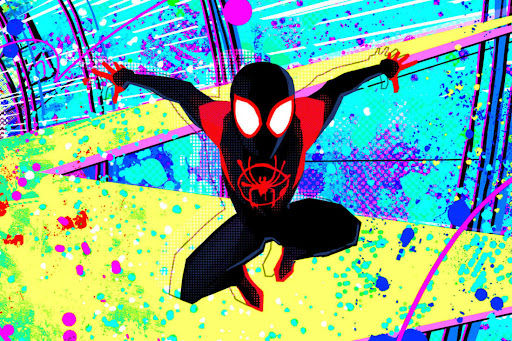
Official illustration of Miles Morales (Spider-Man), embodying the film’s plastic choices through the integration of urban textures and halftone printing patterns, 2018.
However, style is not limited to this perceptive dimension, as it also extends to a thematic level, encompassing narrative structures, systems of values, archetypes, and the underlying imaginaries. Within this framework, visual choices directly influence the interpretation of the narrative, while symbolic concerns, in turn, guide formal decisions. Style thus appears as an integrated system in which the visual and thematic elements constantly interact to produce an experience that is simultaneously aesthetic, cognitive, and meaningful, either by stabilizing meaning through formal coherence, as in The Lion King, or by generating it through hybridization and tension, as in Spider-Man: Into the Spider-Verse.
It is from this perspective that this research draws on a literature review to identify relevant visual, narrative, and symbolic references for the stylistic construction of characters.
Literature review and epistemology: Engelbert Mveng's law of abstraction and synthesis
Character design is a fundamental element in the storytelling of animated films and comics, as it organizes the narrative around a central figure capable of conveying the action, emotions, and symbolic meanings. This figure is not merely a visual representation, but acts as a mediation between the viewer and the narrative universe, whose formal clarity and internal coherence largely determine the impact and comprehension of the story.
In professional practices, character designers have a choice between two major methodological approaches. The first is based on a deductive and structured logic. It is methodical and begins with a written narrative: the creator identifies the character, its physical and psychological characteristics. This process generally relies on the creation of a moodboard⁴ composed of visual references drawn from reality, existing works, or iconographic sources. These elements serve as the basis for developing successive sketches, allowing the exploration, combination, and stabilization of forms, styles, and expressive intentions consistent with the narrative requirements.
The second approach is rooted on an inductive and exploratory logic. Here, the artwork first emerges as an autonomous form, often stemming from a spontaneous creative gesture or free-form visual exploration. The narrative then develops around this initial figure, according to the narrative and symbolic potential it suggests. In this case, the use of a moodboard remains optional and functions more as an auxiliary tool than as a guiding structure.
These two approaches are not strictly opposed, but belong to a continuum of practices that vary according to artistic traditions, production contexts, and creator profiles. However, observations conducted with young comic book, video game, and animation creators in Cameroon highlight a shortage of structured methodological tools in the field of character design. This deficiency limits the formalization of creative processes and can hinder the development of coherent, competitive visual languages adapted with international standards.

Schematic interpretation of Engelbert Mveng’s law of abstraction and synthesis, 2026
In his book L’art et l’artisanat africains², Mveng formulates what he calls the “universal law of Negro-African aesthetic creation,” also referred to as the law of abstraction and synthesis. It describes the way in which traditional African art organizes and transforms visual forms into deep meanings. According to this law, artistic creation does not simply imitate nature, but follows a structured process composed of four complementary moments: mimesis (imitation of nature), abstraction (extraction of essential lines), the formation of symbolic motifs, and the final composition of the artwork.
In this sequence, the artist first observes the real object to grasp its fundamental structure, then eliminates superficial details to extract an essential line that can be transformed into stylized motifs. These motifs, which are meaningful, become the symbolic units of the work. Finally, through composition, these abstract elements are recomposed into a coherent, balanced plastic form, rich in cultural and symbolic meaning. This law does not aim at simple reproduction, but at the transfiguration of reality into meaningful visual language, where form becomes symbol and conveys a worldview.
Applied to character creation, this approach allows for the development of strong visual identities, where every formal choice is significant. The characters become visual syntheses of their narrative role, legible and expressive, while preserving the symbolic coherence of Beti sculpted figures. Thus, the law of abstraction and synthesis offers an innovative methodological framework, linking cultural heritage and contemporary practices, and constituting an effective alternative for the development of original styles in African character design³. The synthesis of this method is presented below:
Structural-symbolic approach to character creation applied to Beti statuary
The development of this new visual creation method arose from observations on character creation approaches in comics and animated films in Cameroon. These observations were conducted primarily in Yaounde and Douala, which concentrate the majority of artists working in these fields. This highlighted a strong influence of external graphic styles on local creative practices. This influence often manifests as the emergence of styles heavily inspired by foreign models, or even as imperfect stylistic reproductions that deviate from African cultural references.
Indeed, the adoption of these external visual styles, while having undeniable artistic merit, can sometimes contributes to the marginalization of African visual heritage. In some cases, local creators simply reinterpret these dominant styles, while others reproduce their codes in an almost mimetic manner. This can be partly explained by the strong international visibility of these graphic aesthetics, particularly those originating from the animation and Western and Asian comic book industries. However, it should be noted that these styles are deeply rooted in the cultures from which they originate and contribute to the articulation of their visual identity.
Indeed, Africa possesses an exceptionally rich artistic and cultural heritage, capable of serving a solid foundation for the emergence of original visual styles in contemporary creation.
In this context, Beti statuary is a particularly interesting example. Cyrille Bela‘s doctoral thesis⁵ identifies several morpho-stylistic characteristics specific to Beti sculptural traditions.
These various characteristics demonstrate that Beti art offers a particularly rich array of formal and aesthetic resources for developing characters with a unique visual identity.
Based on these observations, and drawing inspiration from Engelbert Mveng's law of abstraction and synthesis, we propose a structured seven-phase method for visual creation. This approach aims to guide the creative process from documentary research to the animation phase, integrating various stages such as observation, formal analysis, stylistic interpretation, and reinterpretation of forms.
This approach provides a structured methodological framework for creating characters inspired by Beti statuary, while leaving ample room for spontaneity, experimentation, and the originality of each artist. The various stages of this process are described below.

1. Documentary research (Brainstorming)
The documentary research phase forms the methodological foundation of the creative process by defining the character's core identity within the story. This brainstorming stage focuses on establishing a coherent psychological and physical profile that will serve as a guide for all subsequent formal transformations. By precisely determining the narrative role and physical characteristics from the outset, the designer ensures structural stability and symbolic relevance, facilitating the character's integration into the narrative world. To do this, simply construct the following table:
Categories of analysis
Elements of analysis and detailed characteristics
Physical characteristics
Age, morphology, general stature, and distinctive features (ornaments, ritual scars, cicatrices, accessories)
Narrative role and psychological traits
Function of the character in the plot (hero, guide, antagonist, initiate, symbolic ancestor) and dominant personality traits
Embodied Values
Ethical, cultural, or spiritual principles associated with the character: courage, wisdom, cunning, collective memory, spirituality
Anchoring the figure in Beti statuary during this phase allows for the integration of essential cultural values, such as wisdom and spirituality, into the very structure of the character. This identification of fundamental principles directly influences the structuring of forms, as the choice of a symbolic ancestor role will, for example, dictate the emphasis on the head as the seat of memory. Thus, this initial stage is not limited to a simple description but becomes a genuine system of signs intended to convey a precise cultural message through the final form. It also allows the artist to identify sources of inspiration and create a mood board.
2. Form identification phase (Moodboard)
The moodboard gathers visual references from Beti and Fang statuary, as well as the desired stylistic direction. The aim is not to reproduce works, but to identify the formal principles: verticality, frontality, stylization, and the symbolic relationship of proportions. Among these, one can cite:
-
Slender and refined proportions;
-
The predominance of curvilinear forms;
-
A tendency towards realism in the proportions of the different body parts (head, neck, torso, and limbs);
-
The height of the head is approximately one-third of the total body height;
-
The emphasis on secondary features over overall proportions;
-
A highly realistic treatment of these secondary features;
-
Particular attention paid to decorative details, sometimes sculpted;
-
The frequent use of metal or plastic inlays;
-
The use of paints to enrich the surface of the sculpture;
-
A sometimes rudimentary treatment of finishes;
-
The suggestion of movement in the poses;
-
The diversity of themes represented.


Study of the proportions of some Fang sculptures in Gabon⁶
It should be noted that the aesthetic canons of Beti statuary are generally based on a hierarchical organization of forms. The head, often oversized, symbolizes wisdom, memory, and the connection with ancestors. The torso, elongated and stable, embodies vital force, while the limbs, sometimes reduced or stylized, are subordinate to the symbolic function of the figure. These intentional distortions are neither errors nor anatomical ignorance. They reflect a desire for visual and conceptual synthesis⁷. Form becomes a language, a system of signs intended to convey a precise message. This is a characteristic of African statuary: which prioritize symbolic legibility over physical resemblance. For our moodboard, we will draw on these sculptures:

a. Eton male statue
b. Bakoko male ancestor statue
c. Bakoko male ancestor statue
d. Male statuette from the Yaoundé region
e. Beti protective doll
f. Eton male ancestor statue
g. Eton female statue
h. Male statuette from the Yaoundé region
i. Bakoko male ancestor statuette
j. Manguissa maternity sculpture

Benoît Balla, Moodboard: reproduction from of Beti statuary, 2025, digital illustration
3. Form Geometrization Phase
The geometrization phase is a morphological reduction operation based on principles derived from visual perception and Gestalt psychology⁸. It consists of translating complex volumes into geometric primitives. This includes the cylinder for limbs, the sphere or the oval for the head, and the prism for the torso. This stage aims to stabilize the structure of the character and facilitate its cognitive interpretation. This simplification acts as a process of controlled abstraction, where visual information is organized hierarchically according to essential formal invariants.

Benoît Balla, illustration of the application of the structural-symbolic approach in the creation of a character from a Beti male statue from the Yaoundé region, 2025, Digital illustration
From a technical standpoint, this step plays a fundamental role in the transferability of the model into digital environments (3D modeling, rigging, 2D animation). It allows for the definition of a coherent volumetric architecture, optimizing the handling of proportions, axes, and rotations. This phase can therefore be considered a form of structural normalization, facilitating the creation of the character.
4. Character Design Phase
This creation phase is a crucial moment in the creative process, based on the law of abstraction and synthesis formulated by Engelbert Mveng. It aims to extract the essential structure of a figure from its overall silhouette in order to produce a system of reference forms. The challenge lies in reconstructing the character according to redefined proportions, prioritizing structural logic over anatomical detail. On a formal level, this approach relies on the study of plastic rhythms, particularly the organization of solid and empty forms, as well as on the rigorous identification of axes of symmetry that ensure the overall formal coherence.
The figure's proportions result from a precise geometric deconstruction in which each body segment is integrated into a modular system. The body is thus structured according to measurable vertical divisions, within which the head and neck occupy a dominant position. The head represents approximately one-fifth and one-third of the total height of the body, establishing a ratio similar to certain traditions of Beti statuary. This choice deliberately departs from naturalistic canons in order to emphasize the intellectual and symbolic dimension associated with the head as the seat of knowledge. The elongated neck, as a transitional element between the body and the head, reinforces the verticality of the figure and materializes an axis of communication between the material world and the spiritual realm, a characteristic of these reliquaries.

Benoît Balla, Character analysis and construction, 2026, digital illustration
Simplifying anatomical details in favor of a more legible geometric structure allows for the establishment of a visual rhythm based on the variation of elementary forms. Fundamental shapes such as the circle, triangle, and rectangle become the basic units of the composition. Their arrangement creates a tension of lines that accentuates the verticality of the figure and reinforces its plastic presence. This organization facilitates a synthetic reading of the figure, where each element contributes to a dynamic balance between stability and movement.
The character's identity and symbolic depth emerge from the integration of geometric motifs inherited from Beti sculptural practices. Forms such as triangles, rhombuses, and ellipsoidal structures are used to organize the surface and introduce rhythmic variations. These motifs are not merely decorative but constitute a genuine system of meaning. The circle and oval evoke notions of harmony and completeness, while the triangle and rhombus express dynamics of growth and elevation, both spiritual and social. Through this process of stylization, the representation transcends simple figuration to become a structured symbolic device, in which geometry functions as a formal language in the service of emotional and conceptual expression.
5. Model Study Phase
This stage is more technical than conceptual, employing a systematic analytical approach similar to methods used in industrial design and biomechanics applied to animation. Its aim is to produce visual study boards of the character. It is divided into three main study boards: the study of orthogonal views (front, side view, back); the study of facial expressions; and the study of dynamic poses corresponding to the character's narrative role. This stage can be understood as a technical formalization of the character, where each view acts as a controlled geometric projection.

Benoît Balla, Character turnaround study, 2026, digital illustration
Furthermore, the humanization of facial expressions and dynamic poses is part of a visual semiotics and kinesics logic. It involves identifying the minimal units of expression (micro-expressions, muscular tension, axes of movement) in order to construct an expressive repertoire consistent with the narrative role. This phase thus transforms the character into a system of visual signs capable of producing meaning and supporting the narrative, regardless of its variations.
6. Reinterpretation and Variation of Characters Phase
This conceptual and synthesis phase corresponds to the moment when the designer liberates creativity through mechanisms close to divergent thinking and morphological transformation adapted to the narrative. This involves expressive emphasis through the manipulation of forms and details. Through this process, the character becomes original while remaining rooted in a logic of Beti aesthetics. It is no longer simply about representation, but of producing a meaningful form capable of expressing a narrative and cultural intention.


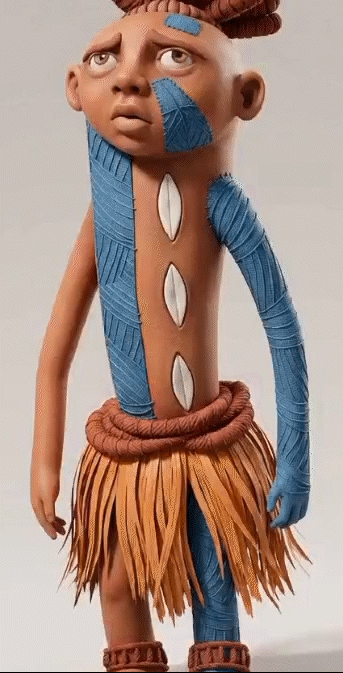
Benoît Balla, interpretation and chromatic variation of the character’s form, 2025, digital illustration
On a theoretical level, this stage can be understood as a process of exploring the space of formal possibilities, where each variation constitutes a visual hypothesis. The grounding in African aesthetic references acts here as a structuring constraint, guiding creativity towards cultural coherence. The result is a hybrid form, both innovative and rooted, which conveys a unique identity of the character.
7. Model Animation Phase
This final phase simply aims to animate the character so that it can be integrated into the animated film it was designed for. It also introduces the parameter of time into the character's formal system, transforming a static structure into a dynamic entity. It relies on principles of cinematics, the physics of movement, and the fundamentals of animation (anticipation, squash & stretch, timing, etc.). Animation tests (walk, run, jump) and some facial expressions are used to validate the mechanical and expressive consistency of the model.


Ⓐ Benoît Balla, Character animation, Studio Ben Tatoo production, May 2026, 4 seconds.
Ⓐ Production Artopia, 2026
Beyond the technical aspects, this stage constitutes a comprehensive functional validation of the character. It allows for the observation of the robustness of the choices adopted in the previous phases (proportions, geometry, expressiveness). It can thus be considered a behavioral simulation phase, where the character is tested under near-real-world narrative conditions. If inconsistencies appear at this stage, it means that certain upstream choices require re-evaluation.
The structural-symbolic methodological approach presented in this second part constitutes a rigorous character design system that harmonizes traditional aesthetic canons with contemporary digital requirements through a structured seven-phase process. Ranging from conceptual brainstorming to functional animation, this method draws on the law of abstraction and synthesis to translate the hierarchical and symbolic proportions of Beti statuary into a coherent geometric language. Ultimately, this synthesis transforms the character from a static cultural reference into a dynamic narrative entity, where every formal choice, from the oversized head to the stylized motifs, acts as a semiotic vector of cultural identity and conceptual expression.
Conclusion
The analysis conducted highlights that the question of style in character design is not simply a matter of aesthetic choice, but rather a structuring issue that involves cultural, cognitive, and economic dimensions. By clearly distinguishing between the visual and thematic levels, the article shows that style functions as an organizing matrix of meaning, capable of orienting the perception and interpretation of works. This understanding makes it possible to move beyond an intuitive approach and situate creation within a methodological and systemic framework.
Furthermore, the structural-symbolic approach appears as a pertinent methodological contribution for the valorization of African heritage in contemporary creation. By translating the principles of Beti statuary into a structured process, it offers creators concrete tools to produce coherent and distinctive forms. It thus contributes to building a culturally anchored visual language that is also adaptable to the demands of today's creative industries.
Ultimately, this research opens important perspectives for the development of African models of visual creation capable of competing internationally. It encourages further theoretical formalization of artistic practices and strengthens the links between heritage, innovation, and economic production. Such an approach constitutes a strategic lever for the emergence of sustainable creative ecosystems and for the assertion of aesthetic sovereignty in the global field of images.
Bibliographic references
Animations
- Inside Out, Pete Docter, Pixar Animation Studio, 2015, 95 min, original language: English
- Spider-Man: Into the Spider-Verse, Joaquim Dos Santos, Kemp Power & Justin K. Thompson, Sony Pictures Animation, 2018, 140 min, original language: English
- Spirited Away, Hayao Miyazaki, Ghibli studio, 2001, 124 min, original language: Japanese
- The Lion King, Roger Allers & Rob Minkoff, Walt Disney Features Animation Production, 1994, 88 min, original language: English
Books
- Cyrille Bela, Pour un autre regard sur l'art Beti, édition l'Harmattan, Yaoundé, 2014, 136 pages
- Christiane Paul, Digital Art, Thames & Hudson edition, Londres, 2015, 272 pages
- Christopher Hart, How to Draw Great-Looking Comic Book Characters, Watson-Guptill edition, New York, 2000, 144 pages
- Engelbert Mveng, L'Art et l'Artisanat africains, Éditions Clé, Yaoundé, 1980, 163 pages
- Marjane Satrapi, Persepolis, édition L’Association, Paris, 2007, 365 pages
- Preston Blair, Cartoon Animation, Laguna Hills, Walter Foster Publishing, 1994, 224 pages
- Susan Mullin Vogel, African Art: Western Eyes, Londres, Thames & Hudson edition, 1997, 312 pages
- Suzanne Preston Blier, African Vodun: Art, Psychology, and Power, University of Chicago Press, 1995, 486 pages
Theses and scientific publications
- Benoît Joseph Balla Owona, Création de personnages en 3D d’un cinéma d’animation inspirée des formes et canons esthétiques de la sculpture Beti, Master’s thesis, University of Yaoundé I, 2018.
- Cyrille Bela, Les expressions sculpturales au sud-Cameroun : cas du pays Beti, PhD thesis, University of Yaoundé I, 2006.
- Louis Perrois, La Statuaire des Fang du Gabon ; Arts d'Afrique Noire, publication scientifique de l'Institut de recherche pour le développement (IRD), 1973.

Benoît Balla
Balla Owona Benoît Joseph is a PhD candidate in visual arts at University of Yaoundé I and a lecturer at the Libre Académie des Beaux-Arts.
Specialized in digital arts, he develops the Structural-Symbolic approach applied to 2D and 3D character design. Structured in seven phases, this method combines technical rigor, formal abstraction, and reflection on the symbolic dimensions of African arts, in dialogue with the thought of Reverend Father Engelbert Mveng.
Through his teaching activities, he supports young creatives in the fields of art, design, and animation. Alongside this, he develops an audiovisual practice focused on animated cinema and experimental creation. He is notably the author of the short films Baobab: The Two Young People (2015) and The Office (2025).
He has also participated in several international workshops and masterclasses, notably in Arles in 2018, affirming an artistic approach open to interdisciplinary and international exchanges.